Setting guide · 01
Tables on Urban Waters
A city’s floating restaurants occupy an interesting threshold: connected to the street, but separated from it by a gangway and a little water.
Operator sources linked · No live status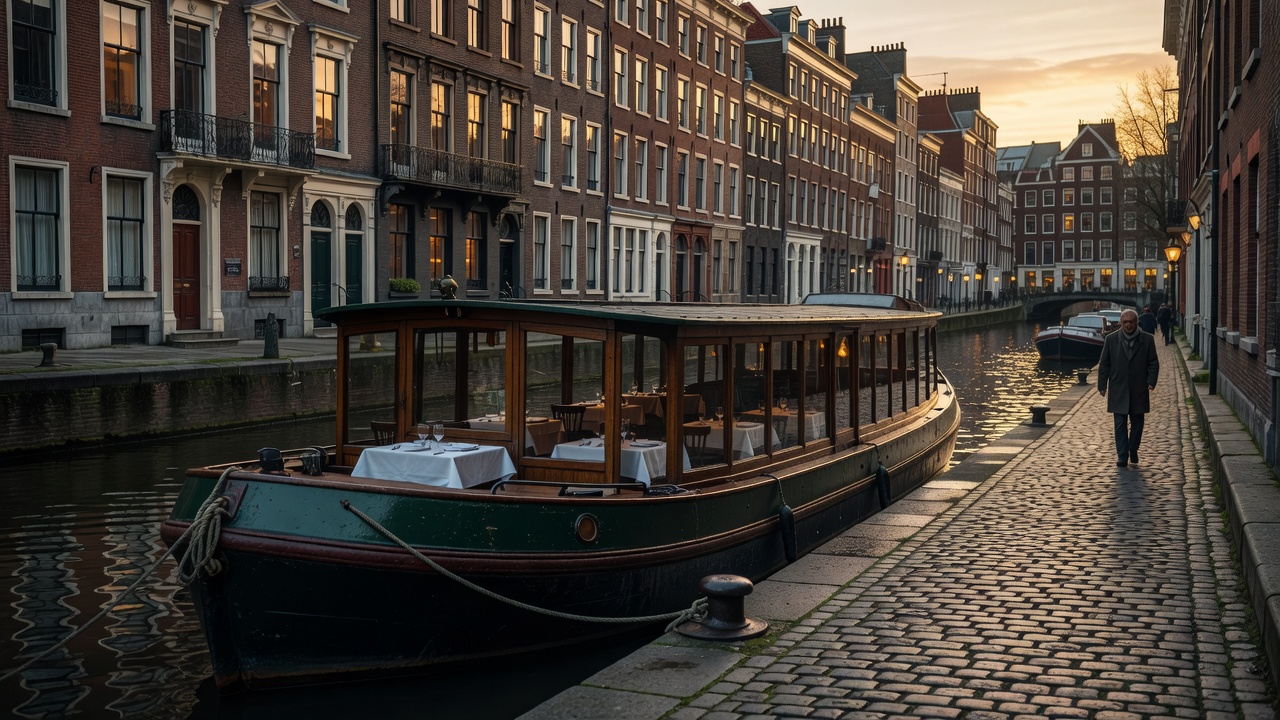
Start with the approach. A river embankment puts a restaurant in conversation with bridges, traffic and broad views. A canal basin brings it closer to apartment windows, office workers and the daily choreography of a towpath. Neither setting is inherently more authentic. They simply offer different ways of noticing the city while sitting down to eat.
It also helps to separate moored restaurants from dining cruises. At a moored venue, the neighbourhood remains part of the experience throughout the meal. A cruising restaurant exchanges that stable relationship for a changing route. Boarding deadlines, journey duration and the possibility of an altered sailing become more important than they would be at an ordinary street address.
London · Canal-side boats
Darcie & May Green
The Daisy Green Collection describes this Paddington setting as boats on the Grand Union Canal. It is a useful example of floating dining woven into a pedestrian neighbourhood rather than separated from the city by a long excursion.
The canal helps frame the place, but does not establish the menu, table layout or access conditions. Those details should come from the operator’s current listing.
Read the operator’s information →London · Thames mooring
Tattershall Castle
Tattershall Castle is a former paddle steamer used as a pub on the Thames near Westminster. Its identity comes partly from the vessel itself and partly from its position within a recognisable riverside cityscape.
Being aboard a historic vessel does not mean the service includes a cruise. Treat the restaurant or pub offering and the boat’s earlier working life as related but separate stories.
Read the operator’s information →Paris: the route becomes part of dinner
Le Calife offers a contrasting model: a restaurant boat associated with dining cruises on the Seine. Here, the setting is not just a berth but a journey. A bridge seen from below, a quay at table height and a bend in the river can change the visual rhythm of a meal in ways a fixed panoramic window cannot.
That is an interpretation of the cruising format, not a guarantee of any particular view or itinerary. Check Le Calife’s official information for the departure point, boarding instructions, route conditions and service format. A restaurant’s postal address and the place where passengers actually board are not always interchangeable. Leave room in your plans to find the correct access to the riverbank.
Amsterdam: a landmark in the basin
Sea Palace is a floating Chinese restaurant on the Oosterdok. Its conspicuous multi-level form makes it an example of the dining venue as a waterside landmark, not merely a discreet room aboard an old boat. The architectural presence is part of its relationship with the city: it is something to see from the shore as well as somewhere to eat.
Do not infer a cultural history solely from a building’s appearance. For a respectful visit, distinguish the operator’s own account, the food actually listed on its menu and the broader history of Chinese dining in the city. They overlap, but one cannot stand in for all the others. The official Sea Palace website is the appropriate starting point for current restaurant information.
Berlin: a smaller urban waterway
Van Loon, at the Urbanhafen, shows how a floating restaurant can belong to a less monumental stretch of city water. The interest here is the proximity of the boat to the surrounding neighbourhood and the possibility of combining a meal with a walk along the bank.
Again, proximity should not be confused with simplicity of access. Steps down to a quay, a narrow boarding route or a change in water level may matter even when a venue appears close to the pavement. Ask the restaurant about the exact route if you use a wheelchair, travel with a pushchair or find steep gangways difficult.
Choose the urban experience, not just the view
If conversation and a flexible arrival matter most, investigate a moored venue first. If the journey itself is the attraction, compare cruising formats and their boarding commitments. In either case, consider daylight, the orientation of the room and whether the table you are discussing is indoors or on an exposed deck. None of those details should be assumed from a promotional photograph.
Finally, give the surrounding place some time. Walking along the canal before a meal, or returning by a public riverside path afterwards, can reveal more about the waterway than a hurried arrival directly from a vehicle. Respect barriers, private moorings and operational quays: the shortest-looking route is not necessarily a public entrance.
| Setting | What stays central | What to check |
|---|---|---|
| Canal-side mooring | Towpaths and neighbourhood life | Public approach and gangway |
| Broad-river mooring | Vessel character and river views | Deck access and exposure |
| Dining cruise | A moving urban route | Boarding deadline and itinerary terms |